Posts

Creating a Game (Part 7) - The Powers

Image
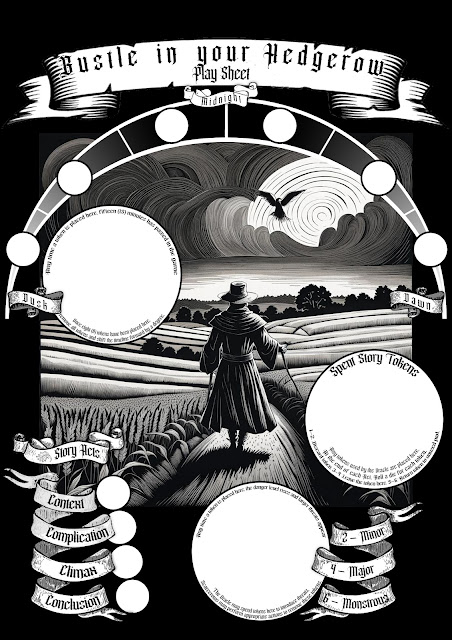
Logical thread 1. Point 1. I've decided to use cards for this game due to the potential for linking the four suits to the four seasons. Point 2. I'm linking the supernatural powers of the scarecrows to the four sesons. Corollary. I should link the powers of the scarecrows to the suits somehow. (Adjunct: There were 4 members of Led Zeppelin, and the lyrics of Led Zeppelin songs were one of the driving inspirations for the game... but sometimes tying to many thngs in just looks forced and trite, so I'm not going to try and push too far in that direction...yet) Logical thread 2. Point 1. For magical powers to feel magical, they need to create effects that are either more powerful than mundane actions, or capable of things that regular people just can't do. Point 2. If the world looks like our world, then there must be something making sure that people with access to magical pwers   Corollary. Magical powers must have a cost associated with them, or have unexpected and rand...

Creating a Game (Part 6) - Who are we dealing with?

Image
They had always protected us from dangers we could never fully understand. Lingering on the edge of villages in fields, they spent millennia sheltering us from the dangers of the nightmarish unknown. But for decades their time seemed to have passed, and the fae of the farmlands and the wilderness had retreated to their dreamlands, leaving the protectors barren. The creatures of the eldritch blackness seemed to have retreated from the world, and while many of the protectors had fallen to the nightmares, just as many in modern nights are falling to neglect and the ravages of time. Now a new threat looms. It appears on the surface as investor greed, capitalist pride, corporate hubris, and simple human desire. The spread of humanity has absorbed the farmlands and threatens the wilderness. The portals that brought the fey into the world are being eaten away one by one. Soon there will be no way for the fae to come into the world and no-one to empower the protectors if they are ever needed...

Creating a Game (Part 5) - The Bits that Drive the Game

Image
 I can see this game being predominantly played two ways; Scarecrow Slice of Life - in which our characters complete a range of small duties for friendly spirits. This helps them build up their mystical energy, and gives them the chance to explore the world, make acquaintances, scout locations, and reveal useful fragments that might be drawn into later sessions.   Tale of Vengeance - in which our characters find a threat to their world and need to confront it because it endangers their acquaintances, their homes, and potentially twists those fragments into something dangerous. This is te kind of things that has been killing the magic in the world, and it could be something as mundane as a property developer sending in their buldozers to destroy a sacred place of power, arsonists hired to clear a family off the frmland that has been in their lineage for generations, or chemical dumpers. Conversely it could be something more mystical, consuming the last remaining energies o...

Creating a Game (Part 4) - Focus and the Power 19

Image
We don't want too many moving parts. There are two rules of thumb in design and general neurology that support this notion.  There are a specific range of neurological tests that have been regularly repeated and tend to produce predictable results. These tests determine how many discreet elements a person's brain can hold at one time in their working memory. This may be done by asking people to memorise a number of words, or objects on a table. It works slightly different to pattern recognition when remembering a sequence on a light-up toy, or memorising digits of pi because patterns can hold several element in place at once. The data suggests that a human mind can handle an average of 7 items in short term working memory. Some folks can only handle five or six, others eight or nine. There are pther factors that vary this, typically reducing the number. If someone is traumatised or anxious, the reason for that emotional state will take the place of a working item in the short t...

Creating a Game (Part 3) - Interlocking systems

Image
I've made single page games, I've seen other people make single page games.  More often than not, these games give you some kind of system that can be used to resolve actions, and some kind of goal or motivator for the characters. In some ways, I guess that's the absolute basic essence of a roleplaying game. The "role" is defined by some kind of goal (that may align with the goals of other characters, or may bring them into conflict). The "game" is defined by a system of dice, cards, "Rock-Paper-Scissors", or other element that helps you resolve how well characters are achieving their goal, or who comes out on top in a conflict. The "playing" in the middle is the grey area where players' imaginations share the narrative, drawing on the goals and systems to help maintain the flow. There are other descriptions...far more elaborate than this one. But then again, there are far more complex games than the single page RPGs I just descri...

Creating a Game (Part 2) - The Basics

Image
 Why create a game? The counter question is "why not?" For most of the duration of this blog's life, the fifth edition of D&D has been the dominant product inthe roleplaying market. It has been the basis of podcasts, it has seen a decent movie come out, it has been the centre of an ecosystem of third party products and has brought tens of thousands , hundreds of thousands , arguably millions of nw players into the hobby. As I said in my last post, D&D (particularly 5th edition) is so ubiquitous that one of the students in my my high school gaming club calls everythig else a homebrew. If I remember the context of his comment correctly, he specifically called Cyberpunk Red a "D&D homebrew".  Yeah, screw that.  D&D's market share has been a blessing and a curse. There are so many better games out there, and so many players who have left the hobby because D&D has not provided them with the experience they were expecting. There's a few rea...

Creating a game (Part 1)

Image
Let's start this year off with the idea of creating a brand new RPG from scratch. I've done this a few times, but there are a couple of students in my high school roleplaying club who have started developing some games of their own, and I figure it might be a good idea to have somewhere to direct them to. There will be some practical examples in this sequence as we work through the development process, and there will be a bit of the theory to back up some of the ideas. Some of those students only have a decent level of familiarity with D&D, but I've tried showing them that other game mechnisms work as well, if ot better for different styles of play...but then again, a lot of those players only really understanding the murderhobo play style, so they view every other game through that lens. One particular student I'm thinking of even calls every game a "homebrew" if it isn't run specfically verbatim from a book with a "Dungeons and Dragons" log...