Posts

The Caves of the Endless Chant

Image
The slowly drifting river weaves it's way through the karst mountains on the edge of a decaying kingdom, once a part of an empire now forgotten. Few modern maps detail the path of the river, fewer still mark the location of scattered caves or the mountain temples inhabited by hermits and esoteric mystic orders. Only a single map indicates the point where the river not only weaves around the jutting spire, but also cuts through the limestone karst. No maps indicate that the underground path of this river branch houses ancient temples at the entrance and exit of its subterranean journey. In the great purges of heresy, many monks in temples like these were hunted down for their sacrilegious beliefs... but not the monks of this nameless ancient order, those known locally as the monks of the endless chant. Those who know the history of this place claim that the endless chant keeps an ancient evil trapped within the bowels of the cave system. The monks themselves never delve into th...

A Comprehensive Look at The Tower

Image
Over the last week or so, I've been drawing a series of maps depicting an arcology city in the vein of "Peachtrees" from Dredd. It started as an idea for the Mage stuff I've been working on, a self contained setting for a more cyberpunk take on the genre, but over the last week it took on a life of it's own. The project began with a series of floor plans for various layers. There were no specific plans for what might exist where in the complex. Instead they were just interesting shapes with elevator shafts designed to line up, and where the various layers started larger on the lower floors and gradually became smaller as the altitude rose. Of course, this means my building has a fundamentally different shape to Peach Trees, where mine is more pyramid and Peachtrees is more like a prism. I ran some numbers through my building, where the lower layers would have an average of 6 people in each walled off apartment area, while the apartments at the highe...

To mash or not to mash

There's a common practice in design circles where designers (and I hesitate to use the term "designer" in some cases, because this practice sometimes feels lazy and derivative) get two existing games, picking and choosing elements from each to create an unholy hybrid. Sometimes it works, sometimes it doesn't. So many of those hybrids recently have been PbtA products (which seem to be the current face of Story Games), or D&D products (which are basically the face of the OSR). I've seen the abysmal horror of a Storyteller system/PbtA hybrid, and don't want to walk any variant of that path. I similarly don't think that a "Mage:the Ascension / Dungeon and Dragons" hybrid will work. Still, there is the adage that sometimes you don't need to reinvent the wheel. It's just a case of picking the right games to mash together, and maintain the elements from each that give the right direction to the final project. I discussed this in a pr...

Collaboration in Definition

Image
In response to my " Say No and Roll the Damn Dice " post,  +Tony Demetriou  posed an idea by which players might define elements of the story's antagonists. The idea was specifically posed in the context of D&D monsters, but there's no reason why it couldn't be used in a Mage context, especially if that context was a more stripped back version of the game. Before we can follow that path, it might be necessary to work out how the game is being stripped back. In an earlier incarnation of the project, I was looking at the idea of maintaining the existing character sheets and stats inherent in Mage and trying to work a simpler system through them. This could be feasible, but I haven't worked out a clean way to do it. I'm thinking it might be easier to strip things back to an approximation of the Minds Eye Theater rules. Instead of nine attributes in three categories (Physical = Strength, Dexterity, Stamina, Social = Charisma, Manipulation, Appearan...

They're Coming to Take Me Away, Ha-Haaa!

Image
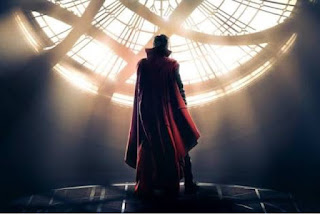
< SPOILER ALERT...there are things in this post relating to the movie Dr. Strange. If you've read the comic or know about the character, these won't be much of a surprise... In fact, if you've noticed the pattern of superhero movies in the last 20 years, they probably won't come as much of a surprise either. I'm just letting you know...> In Mage: the Ascension, there are a four wider factional groupings. These groups sits at the corners and at the centre of a triangle. On one point of the triangle you have the agents of stasis, the "Technocracy", who basically want order in the world and want magic destroyed (they don't believe what they do is magic, even though other groups do see it that way). On another points of the triangle you have the agents of chaos, the "Marauders", who are basically insane with incredible willpower and a faith in their delusions so strong that those delusions leak over in our reality with their insanity. T...

Say No, and Roll the Damn Dice

In a private post on G+,  +Jesse Burneko  made a point that relates tangentially to something that has been festering in my head for a few days. In my recent post entitled " Another Perspective ", I indicated that I thought something was really missing from the perspective provided in the accompanying video, and I feel that Jesse's words provide another part to the puzzle. The idea is that there was a seizmic shift in independent gaming, where a lot of designers deliberately added improvisational stuff into their games through the mantra of "Say Yes, or roll the dice". This deviated into the concepts of "Yes, and... / Yes, but..." where anything that is said in a game basically becomes an irrefutable fact, but it can be augmented or diminished through further explanation that comes later. The whole idea here is to produce an environment where everyone feels they are contributing to the unfolding narrative in a meaningful way, rather than simply havin...

The Story Inherent in the Story Game

Image
When I think of a story game, I tend to think of a game that produces a specific type of story. It may be a war story, from the perspective of children forced to confront horrors that they reall shouldn’t be emotionally able to handle (Grey Ranks), it could be a ritualised fantasy (Polaris), a tale of confronting one’s identity as a servant to a monster (literally or figuratively) (My Life with Master), a teen metaphysical angst drama thinly veiled by supernatural stereotypes (Monsterhearts). Each type of story game weaves a specific type of narrative consistently. Usually I prefer to mix things up in my campaign games, so I’ve found most games of this nature don’t hold my attention for long… “we’ve already told variations of that story a half dozen times, can’t we do something else now?” The kinds of stories I’d be interested in revisiting time and again don’t necessarily work well with this type of game…actually, in all honesty, there might be some awesome games out there that f...