Posts

Showing posts with the label Story Games

Mash-Up

Image
 Two nights ago, we had another "Medieval Tavern Night" at The Press Basement Bar .  It's been an erratic night. The first event was meant to be held in February but got pushed back to March, we had about 18 players, with 3 sessions at 6 per session, and another dozen or so Magic players (I think), who were participating in a card tournament. I ran an open exploration game focused on a ruined city that covered an island. It was once the capital of a corrupt and ancient kingdom. The each had goals on the island, it worked fairly well.   The second event was in April but coincided with ANZAC day, and a lot of people figured it would be called off, or simply had other plans. We had two games running, and I think there were some Magic players again. I ran 8 that night, where a bunch of the players had been in my session on the first night. For this session I ran a heist. All the characters were half-animal races, so I pitched it as Oceans 11 meets Zootopia. It was basica...

Tenth Anniversary Post

Image
This is the 10th anniversary of the blog. I wouldn't have even noticed that I'd started the blog on the 3rd of April 2008, and that exactly a decade has elapsed except for the fact that I was digging back thrpugh some archives, trying to work out how my current thoughts on game design have changed since I started this whole thing. It looks like I started the blog as a means to vent frustrations over work, I had left a toxic workplace amd had started studying web design at TAFE (A government operated vocational college, for those who aren't in Australia). I guess I was either bored in the class, or we were doing a unit of work about blogs and online journals. Statistics show that the first few years didn't see a lot of action. That's probably due to the meandering subjects, the lack of focus, and the fact I didn't have the blog linked to any particular social media... numbersicked up for a while when there was a Facebook app directly feeding my posts he...

On the Publishing of Rules

You walk into your friendly local gaming store (FLGS) and look at the new expansion book(s) for your game of choice... or maybe you're a story gamer and you heard great things about this new game, that does "this awesome thing"... or maybe you're an OSR type and you decide to look at a product that does one thong a bit differently to everything else, or introduces a new character type... ...but then you look at your book of choice, and the bit that interests you is a single page, maybe two or three...half a dozen if you're lucky. In standard publishing, the book has a page count with a multiple of 16 pages, so your typical story-game or OSR supplement might be 32, 64, or 96 pages, and your typical mainstream supplement might be 160 or 240 pages. In some instances there might be an additional rule idea hidden in the pages that proves valuable, and maybe a decent chunk of the book is dedicated to a scenario that you might play once, only to find that your players ...

Collaboration in Definition

Image
In response to my " Say No and Roll the Damn Dice " post,  +Tony Demetriou  posed an idea by which players might define elements of the story's antagonists. The idea was specifically posed in the context of D&D monsters, but there's no reason why it couldn't be used in a Mage context, especially if that context was a more stripped back version of the game. Before we can follow that path, it might be necessary to work out how the game is being stripped back. In an earlier incarnation of the project, I was looking at the idea of maintaining the existing character sheets and stats inherent in Mage and trying to work a simpler system through them. This could be feasible, but I haven't worked out a clean way to do it. I'm thinking it might be easier to strip things back to an approximation of the Minds Eye Theater rules. Instead of nine attributes in three categories (Physical = Strength, Dexterity, Stamina, Social = Charisma, Manipulation, Appearan...

They're Coming to Take Me Away, Ha-Haaa!

Image
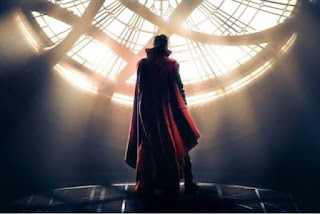
< SPOILER ALERT...there are things in this post relating to the movie Dr. Strange. If you've read the comic or know about the character, these won't be much of a surprise... In fact, if you've noticed the pattern of superhero movies in the last 20 years, they probably won't come as much of a surprise either. I'm just letting you know...> In Mage: the Ascension, there are a four wider factional groupings. These groups sits at the corners and at the centre of a triangle. On one point of the triangle you have the agents of stasis, the "Technocracy", who basically want order in the world and want magic destroyed (they don't believe what they do is magic, even though other groups do see it that way). On another points of the triangle you have the agents of chaos, the "Marauders", who are basically insane with incredible willpower and a faith in their delusions so strong that those delusions leak over in our reality with their insanity. T...

The Story Inherent in the Story Game

Image
When I think of a story game, I tend to think of a game that produces a specific type of story. It may be a war story, from the perspective of children forced to confront horrors that they reall shouldn’t be emotionally able to handle (Grey Ranks), it could be a ritualised fantasy (Polaris), a tale of confronting one’s identity as a servant to a monster (literally or figuratively) (My Life with Master), a teen metaphysical angst drama thinly veiled by supernatural stereotypes (Monsterhearts). Each type of story game weaves a specific type of narrative consistently. Usually I prefer to mix things up in my campaign games, so I’ve found most games of this nature don’t hold my attention for long… “we’ve already told variations of that story a half dozen times, can’t we do something else now?” The kinds of stories I’d be interested in revisiting time and again don’t necessarily work well with this type of game…actually, in all honesty, there might be some awesome games out there that f...

Backgrounds

One of the things I really like about the Storyteller system is the way a character's backgrounds integrate them into the setting. It doesn't matter what the background is, it serves a mechanical advantage and it can be used as a narrative hook for ongoing story. One of the things I don't like about the backgrounds in the Storyteller system is the way there is no real consistency in the way they manipulate the mechanisms of play. Some backgrounds reduce difficulties, other backgrounds provide additional dice, some reduce experience costs over the course of play, and then there are those which provide more powerful abilities to completely circumvent certain types of situation. To streamline and simplify Mage, I think backgrounds are one of the key elements to play with. Perhaps by developing of single background system with a consistent mechanism, but where each background is limited in it's sphere of influence, and each use of a background is a tug on a string which...

How Mage went halfway, but didn't quite finish.

At the time of it's release, the Storyteller system had some great ideas. Some really pushed the potential of roleplaying, some were just codified instructions for what a lot of us did around the table anyway, and some opened the door for later innovations. The idea of multiple degrees of success was always an interesting one; coupled with the concept of the "botch", it gave a fun progression of linear outcomes to a task resolution. When I was developing my Vector Theory of roleplaying back in 2010, I said that the story parts of an RPG session were generally straight lines (vectors), while the game elements were "node" points where the narrative might change speed or direction. In a traditional railroaded game, these nodes might act as traffic lights, stopping and starting the flow of the narrative depending on whether the characters failed or succeeded. In some of the more interesting traditional games, there might be switch points along the railroad, where...

Storifying Mage: Revisited

All this talk of Mage:the Ascension has returned my thoughts to the abandoned project of making a stripped back version of Mage. I wanted it months ago, I basically wanted it when I saw the monster 700+ pages of the M20 edition, and now it seems that a few more people want it. I suspect my original ideas of maintaining character stats, but playing with the underlying systems may prove unfeasible at this time. Instead, I'm seriously thinking of a FUBAR/Mage mash-up. This would use a quick customisable multi-template system to create characters, and a conversion system to adapt existing NPCs and starting characters in sourcebooks. If it works, it'd be interesting to generate variants covering Werewolf and Vampire, and maybe a few other games in the World of Darkness.

5e, OSR, other???

I'm starting to womder if I should just write a setting, or a hack that can be used with 5e, or with one of the many flavours of OSR, or one of the other syste,s that has some kind of open license. Personally, I've always thought that this was a cop out... like sticking a new coat of paint over something that everyone else has already got. I wouldn't buy a product that was in this vein, but it looks like there are a lot of folks out there who would. My artistic integrity says "no", my contemplation of monetary issues says "yes". Artistic integrity is winning out at the moment.

Status among Game Designers

I've been considering status among the design community for a while...How certain game designers can pump out half finished crap and be praised for innovation, while others plug away at truly polished products only to be ignored. Matthijs Holter has set up a thread over on Story-Games to discuss status as it relates to designers within that community. Paul_T   (I find it fascinating that this thread, of all threads, is bringing out so many observers and lurkers! Why is that?)   Matthijs  Excellent question! While high-profile posters mostly stay away.  ChristopherWeeks  Huh.  My first thought was that maybe it's a little embarrassing to acknowledge that you're one of the highest-status people.  These are just my theories, and I'm deliberately avoiding the use of specific names of people or games...  I think it's the whole notion of the privileged few versus the unprivileged masses. The few have power far beyond their numbers ...

Stories and Investigation

Image
There is something that drives all stories, whether the dramatic tension of a inter-character relationships, the adrenaline pumping of an action adventure or the shrouded enigma of a mystery. In every story, there is something that stands in the way of one party achieving their goals...if the goals had no obstacles, they wouldn't be goals...and if they were easily achieved, then there wouldn't be much of a story. Every type of story has obstacles, the genre of the story simply defines the type of obstacles expected. For decades roleplaying has done action-adventure, where the obstacles are monsters, traps and magical curses. For years, recent games have started to master the notion of interpersonal drama, where the obstacles are rivalries, love triangles, and situational triggers that prompt a characters primal drives in a given direction. But recently, I've been hearing questions about ways to run a good investigation or mystery. These have been popping up in a f...

My overview of the past few years in indie gaming

Over the past few years I've used this blog to look at RPGs from a variety of angles. I spent a year going through game mechanisms, one per week. Looking at how they might be used, the effects they produce within the play environment and methods for using them in unconventional manners. This was a great exercise to see what sorts of play mechanisms exist within the RPG community, beyond simply rolling a d20, comparing it to a nmber and interpreting the result. I spent the better part of a year developing my own metaphor theory for how RPGs actually work. A lot of work has been done by numerous people to describe how players interact with the mechanisms and pushing into the social theory behind roleplaying games, but this project had the aim of describing the fundamentals of play...when is story told? when are decisions made? how do these two options feed back into one another? What types of play experience tend to manifest when...