3D Terrain
When I run games, I try to limit the potential for players to diverge in their understanding of the 3D space in their imagined versions o events. I like everyone to be on the same page, and to share a collective understanding of how things are unfolding, especially when a game starts getting tactical. A lot of this probably comes from playing with miniatures where the tactical play is literally laid out with physical pieces of terrain and small figurines that depict the characters.
Don't get me wrong, a also like a good game where theatre of the mind has been executed well...but I've see so many arguments at tables of the years where one person has a distinct impression of how things are unfolding while another person is viewing things in a very different light. In such a case, both might be valid interpretations, but are often irreconcilable. The slowing down, and sometimes complete disruption, of the game is undesirable. It's probably one of the reasons I like a good LARP, the raw physicality overco0mes a lot of this.
At the tabletop, there's been a push toward "Virtual Table Tops" and doing things digitally, but I'm still a bit old school when it comes to establishing elements that help shape the session. You've probably seen my hand drawn map tutorials (with hundreds of thousands of views between them), with some lesser viewed tutorial series on painting miniatures and terrain.
However, I've also been fond of physical terrain pieces and I'm mentioned them a few times over the years.I love the Dungeons and Lasers system from Archon Studio, and bought into their first kickstarter a few years ago. They've been my "go to" modular terrain building kit for about five years now, but in recent weeks I found the Open-Lock system, and since I've got a 3D printer and a bit of CAD experience, I thought I'd tinker with these.
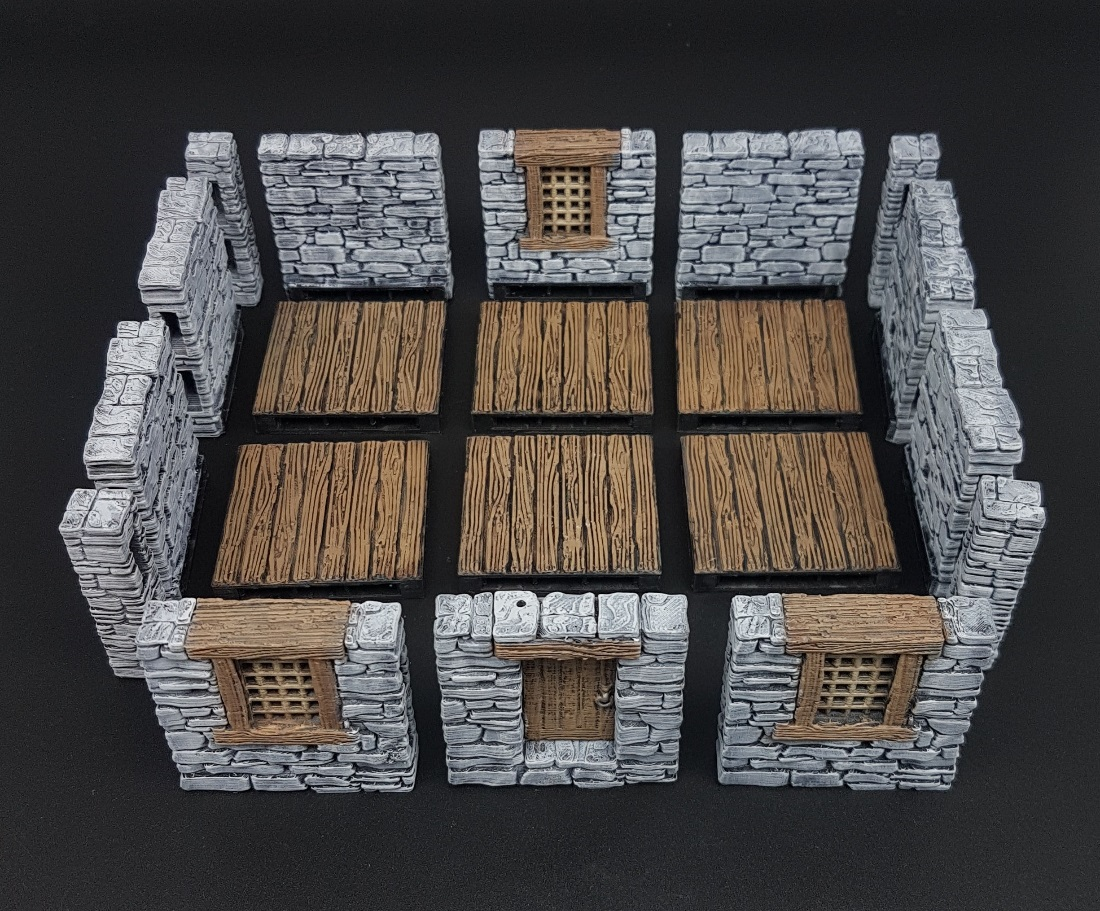
(Image from https://www.terraintinker.com/knowledgebase/openlock-assembly-guide)
There are heaps of people who have already been working in this space, which plenty of resources available of the various 3D printing resource pages. (I'll do a post about a few of them shortly).
My first adventure in modification has been to revisit my "Voidstone Chronicles" idea, where the game is set on giant discs floating in the eye of a chaotic magical storm. So, to do this, I needed to convert the square grid of the Open-Lock modules into a few that could form circular borders.

I'm not 100% happy with them yet, because I just assembled a few large square forms, then traced a circle over them and scaled it to a few different sizes until I found a few scales that felt like they'd work. Making sure there'd be enough places for joiner-clips to keep them stable, avoiding too many fragments without curves on them, and making them big enough so that a few different circular disc could be made, hopefully with a couple of viable structures on them. With those ideas in place, it was a simple boolean (keep the bits in the circle, cut away the bits outside the circle). I've printed them off to test my proof of concept, but next I'll be cleaning up the edges a bit to make them prettier.

The next experimentation has involved combining models from different sources.
I found a cool set of battlefield trenches, and figured I could attach these to the Open-Lock base plates. So far I have combined some straight bits of trench, some corners, a couple of openings, and mixed an matched a few bits to get the "encampment" area shown above.
I've still got plenty of ideas here, but I think I'll be focusing on "outdoor" modular tiles, because there's already plenty of dungeons, buildings, and ruins in the system, but not much in the way of hills, roads, and exteriors. I could be wrong...more exploring to do.
Comments